
Ruben Haalebos | CREST, ENSAE Paris, IP Paris and EDF R&D
Peter Tankov | CREST, ENSAE Paris, IP Paris
OPeration “Epic Fury”, launched by the United States (US) and Israel against the Iranian regime, is reshaping energy markets. Although the European Union is not directly involved, it remains exposed because of its dependence on imported fossil fuels. Following the increase of gas prices, electricity rose in Europe, as they remain relatively correlated. This increase nevertheless remained limited compared with the surge triggered by Russia’s invasion of Ukraine in February 2022. While the two shocks differ significantly in scale, both highlight Europe’s structural dependence on imported energy. This dependence leaves the continent vulnerable to external political decisions and supply-chain disruptions, underscoring the need for greater control over domestic energy production. Electrifying end uses with decarbonized electricity is one way to strengthen that control. Beyond its climate benefits, this strategy would also make the European economy more resilient. In this context, carbon markets such as the EU ETS can play a central role, provided that the revenues are directed toward energy efficiency and decarbonization investments.
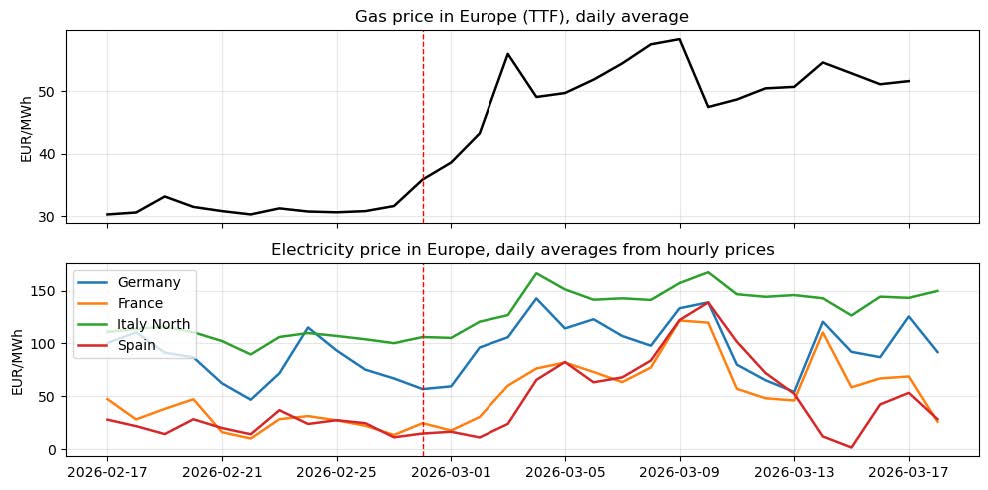
The US-Israeli military campaign against Iran is adding upward pressure to global fossil-fuel prices. The main channel is the disruption of shipping through the Strait of Hormuz, one of the world’s most important energy chokepoint. About 20% of global oil and liquefied natural gas (LNG) consumption moves through the strait [1], with limited scope for re-routing. Unsurprisingly, energy markets have responded immediately (Figure 1). European benchmark gas prices have jumped by more than 50% since the conflict began, and oil prices have also risen sharply. This has fed into European wholesale electricity prices, raising concern about renewed energy-market stress.
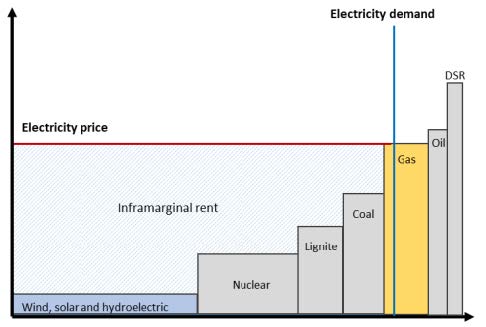
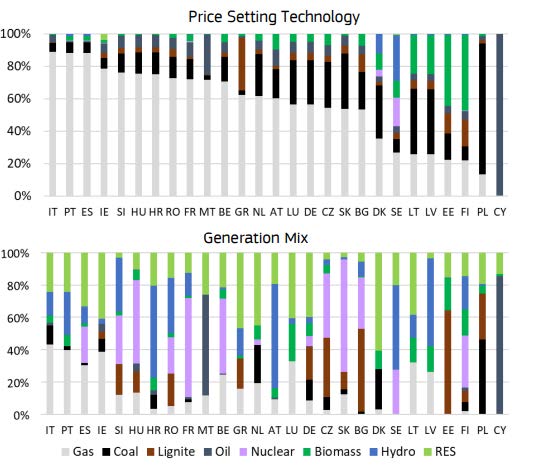
Even though the current electricity price shock is still far less severe than the one Europe experienced in 2022, the mechanisms that led to this increase are similar. As explained in [2], natural gas can have a strong influence on power prices in Europe, even though it does not dominate electricity generation. The reason lies in the marginal-pricing structure of wholesale electricity markets: prices are set by the last unit required to meet demand, as depicted in Figure 2. Gas-fired power plants frequently occupy this position, which means that gas prices can shape wholesale electricity prices far beyond gas’ direct share in the generation mix. Figure 3 illustrates this effect, for the year 2022. Because fuel costs make up a large share of the operating cost of gas-fired plants, increases in gas prices quickly feed through into electricity prices. This helps explain why the European power system remains highly exposed to volatility in gas markets and to external supply shocks [2, 3].
The present situation differs materially from that of 2022 [4]. At the time, the European energy system was already operating under unusual strain: drought depressed hydropower output in several countries, while nuclear maintenance in France further tightened electricity supply. In addition, the absence of an effective coordination mechanism meant that European gas buyers were often competing against one another in global markets. Europe is better positioned today. Installed wind and solar capacity has increased by 57% since 2021, joint gas purchasing has improved coordination, and gas demand from energy-intensive industries remains structurally below pre-crisis levels.
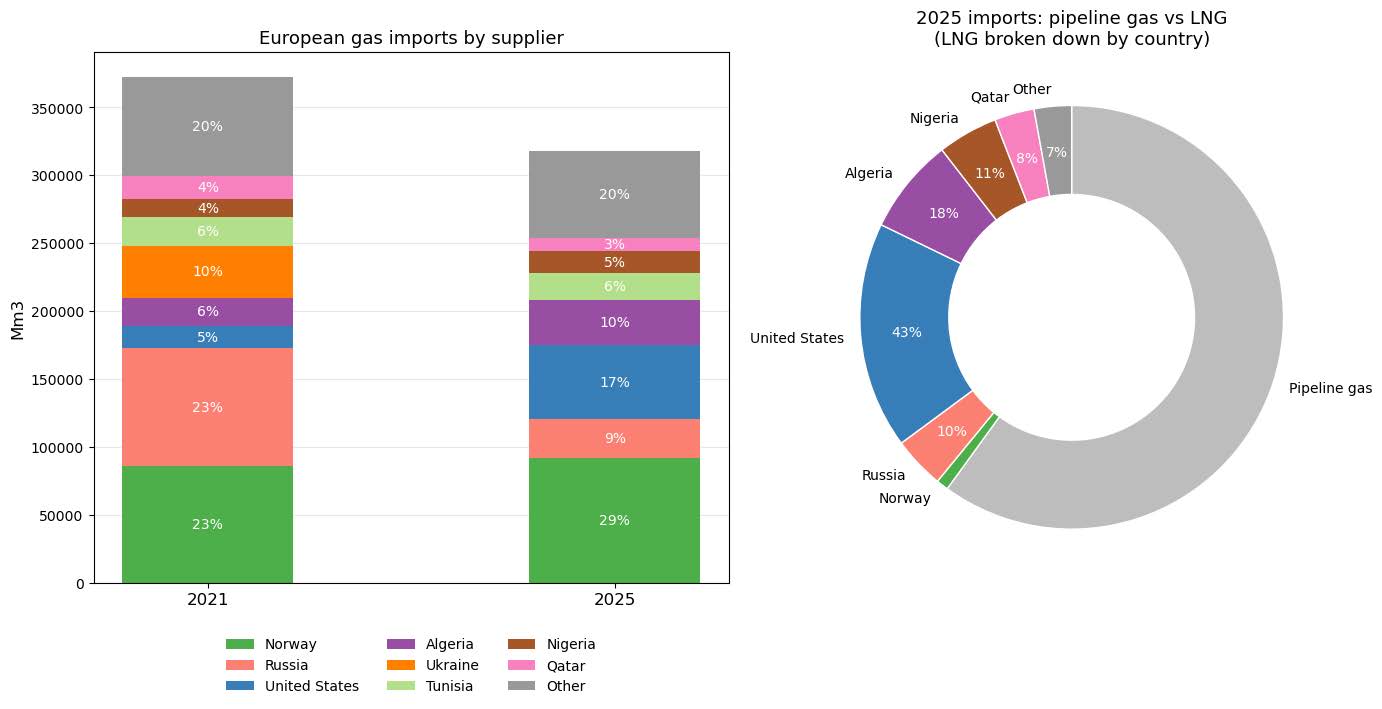
Furthermore, the nature of the shock is different. In 2022, Europe was facing a structural break in its energy supply, as replacing Russian gas required a profound reorganization of import routes and procurement strategies. Today’s shock is more narrowly geopolitical in nature. In 2021, Russian gas accounted for a little than 40% of total import¹, so reducing that dependence demanded a substantial adjustment. Since then, Europe has expanded its LNG import capacity and diversified its supply base. As Figure 4 shows, the composition of European gas imports is now very different: Russian gas no longer occupies the dominant position it once did, while imports from Norway, the US, and Algeria have become more important. LNG, especially from the United States, now plays a much larger role.
Altogether, Europe is not directly exposed to a disruption of the Strait of Hormuz in the same way it was exposed to the loss of Russian pipeline gas in 2022. Qatar accounts for only around 3,5% of the EU’s overall gas supply, so a blockade would not generate an immediate physical shortfall. The larger risk is indirect and operates through the global LNG market. Because more than 80% of Qatari LNG exports are normally shipped to Asia, any prolonged disruption would force Asian buyers to compete for alternative cargoes, tightening global LNG balances and pushing prices higher. Europe is therefore more diversified than it was in 2022, but it remains exposed to global gas-market tensions an to price shocks transmitted through LNG trade.
This exposure can be seen, in part, as a temporary consequence of its transition strategy in the power sector. Coal plants have progressively been retired and replaced by renewables and natural gas. While this has supported decarbonization, it has also left gas-fired plants in a central role in price formation, bu the mechanisms described above. This haas in turn fueled a broader political debate about the costs and design of the decarbonization agenda. The recent debate over the EU ETS reflects this tension. For example, Italian Prime Minister Giorgia Meloni called for its suspension: “With the outbreak of the crisis in the Middle East, the issue of energy prices has clearly become even more important, which is why, at European level, we are also calling for the urgent suspension of the application of the ETS to electricity production” [5].
On the contrary, we view the EU ETS as en essential tool of the European Union climate policy. As the EU’s central policy instrument for advancing decarbonization, it contributes to reducing reliance on imported fossil fuels and thereby reinforces strategic autonomy. The case for reducing Europe’s dependence on fossil fuels is not limited to long-term climate benefits and lower greenhouse-gas emissions(GIIG) emissions. It also has important short-term advantages. In a context in which multilateralism is increasingly perceived to be in retreat [6], and where geoeconomics confrontation or regional conflicts may become more frequent, energy supply chains are likely to face renewed disruption. From that perspective, the development of renewable energy is not only a decarbonization strategy, but also a resilience strategy. Although renewable technologies are not entirely detached from global supply chains-given Europe’s continued reliance on imported equipment, particularly from China-they are far less vulnerable to abrupt fuel-price spikes and external supply interruptions tan fossil-fuel-based energy systems. Decarbonizing Europe’s power system is therefore not only about climate policy; it is also about strengthening economic resilience, energy security, and strategic autonomy.
¹ This number accounts for direct supply as well as gas transiting through Belarus and Ukraine.
References
[1] Reuters. Gulf oil producers scramble to bypass Hormuz as Iran locks down the Strait, 2026.
Graphics page: Maps and charts of the Iran War. Accessed March 18, 2026.
[2] Behman Zakkers, Iain Staffell, Paul E. Dodds, Michael Grubb, Paul Ekins, Paulina Jaramillo, and Giorgio Castagneto Gissey. The Role of natural gas in setting electricity prices in europe. Energy Reports, 9: 16808*16822, 2023. ISSN 2352-4847. doi: 10.1016/j.egyr.2023.09.069.
[3] Jorge M. Uribe, Stephania Mosquera-López, and Oscar J. Arenas. Assessing the relationship between electricity and natural gas prices in european markets in times of distress. Energy Policy, 166:113018, July 2022. ISSN 0301-4215. doi: 10.1016/j.enpol.2022.113018.
[4] Warren Patterson. 7 reasons why Europe can deal with a gas shock better than in 2022, March 2026. ING THINK article, accessed March 18, 2026.
[5] Federica Di Sario. War-driven energy prices put EU carbon market under fire, March 2026. The Parliament Magazine, accessed March 18, 2026.
[6] World Economic Forum. The global risks report 2026. Global risks report, World Economic Forum, January 2026, 21st edition, published January 14, 2026.