

We are delighted to share that Roxana Dumitrescu (CREST – Groupe ENSAE-ENSAI) has been awarded the 2026 EIF–SCOR Foundation Prize of the Institut Louis Bachelier in the category of Best Young Researcher in Finance and Insurance.
Roxana is an expert in stochastic control and financial mathematics, with a broad research scope. Her recent work significantly advances mean field game theory and its applications, particularly in the context of the energy transition.
Established in 2005, the prize is awarded annually to researchers under 40 who have made a significant contribution to finance, insurance, or risk analysis.
This year, the prize is jointly awarded to Roxana Dumitrescu and Sylvain Carré (Université Paris 1 Panthéon-Sorbonne). The award was presented by Elyès Jouini, Academic Vice-President of the Institut Louis Bachelier, alongside a representative of the SCOR Foundation.
This recognition speaks to the exceptional quality of her research and the growing attention it is attracting across the academic community.
Everyone at CREST extends their warmest congratulations to Roxana on this well-deserved achievement.
Assurance chômage : de nouvelles analyses remettent en question le durcissement des règles d’indemnisation

Les réformes successives de l’assurance chômage ont, ces dernières années, renforcé les conditions d’éligibilité et réduit la durée d’indemnisation dans l’objectif d’inciter à un retour plus rapide à l’emploi. Toutefois, de récents travaux du Conseil d’analyse économique, auxquels a contribué Roland Rathelot, invitent à nuancer l’efficacité de ces mesures.
L’étude met en évidence que le durcissement des règles ne produit pas les effets attendus en matière de retour à l’emploi, en particulier pour les publics les plus fragiles. Au contraire, ces politiques pourraient s’avérer coûteuses socialement, en accentuant la précarité de certains demandeurs d’emploi, sans gains significatifs en termes d’insertion durable.
Les chercheurs soulignent notamment que les individus les plus affectés par ces réformes sont souvent ceux déjà éloignés du marché du travail, pour lesquels les incitations financières jouent un rôle limité face à des contraintes structurelles (qualification, état de santé, conditions locales du marché du travail).
En parallèle, les travaux explorent des pistes alternatives, notamment une différenciation des règles selon les profils. Si un durcissement généralisé apparaît peu efficace, certaines adaptations ciblées pourraient être envisagées, par exemple pour les travailleurs seniors, dont les trajectoires professionnelles présentent des spécificités importantes.
Ces résultats contribuent au débat public en apportant un éclairage empirique sur les effets des politiques d’assurance chômage. Ils rappellent l’importance de concevoir des dispositifs à la fois efficaces économiquement et soutenables socialement, en tenant compte de l’hétérogénéité des situations individuelles.
Références presse
-
BFM TV, « Inefficace et coûteux pour les plus précaires : le Conseil d’analyse économique appelle à arrêter de durcir le régime de l’assurance chômage », avril 2026
-
L’Opinion, « Ce nouvel indicateur économique qui suggère de supprimer la filière seniors de l’assurance chômage », avril 2026
-
L’Info Durable, « Assurance chômage : il ne faut pas durcir les critères d’éligibilité selon une étude », avril 2026
-
Wansquare, « Le durcissement de l’assurance chômage ne serait pas miraculeux », avril 2026
-
Ouest-France (édition Angers / maville.com), « Assurance chômage : une étude remet en cause l’efficacité du durcissement des critères d’éligibilité », avril 2026
-
Yahoo News, « Les personnes affectées souvent précaires, selon le CAE », avril 2026
-
Notre Temps, « Assurance chômage : il ne faut pas durcir les critères d’éligibilité, selon une étude », avril 2026
-
Challenges, « En finir avec la frénésie de réformes de l’assurance-chômage : ce rapport qui passe au crible les choix d’Emmanuel Macron », avril 2026
-
Le Monde, « Assurance-chômage : une étude appelle à repenser la façon d’envisager les réformes », avril 2026
-
Les Echos, « Assurance-chômage : une approche inédite pour en finir avec les réformes à répétition », avril 2026
-
La Correspondance économique, « Réforme de l’assurance-chômage : une note du Conseil d’analyse économique recommande de ne pas durcir les conditions d’éligibilité », avril 2026
-
Libération, « Durcir les critères d’éligibilité au chômage n’est pas une mesure efficace, selon le Conseil d’analyse économique », avril 2026
-
Nice-Matin, « Ne pas durcir les critères d’éligibilité, supprimer la bonification des 55-56 ans… : les recommandations du Conseil d’analyse économique sur la réforme de l’assurance chômage », avril 2026
-
Le Télégramme, « Assurance chômage : il ne faut pas durcir les critères d’éligibilité, selon une étude », avril 2026
-
Sud Ouest, « Assurance chômage : il ne faut pas durcir les critères d’éligibilité, selon une étude », avril 2026
-
Le Courrier de l’Ouest, « Assurance chômage : une étude remet en cause l’efficacité du durcissement des critères d’éligibilité », avril 2026
-
TradingView, « Assurance chômage : il ne faut pas durcir les critères d’éligibilité, selon une étude », avril 2026
-
MoneyVox, « Assurance chômage : le Conseil d’analyse économique déconseille de durcir les critères d’éligibilité », avril 2026
-
Econostrum, « “Les personnes affectées sont souvent précaires” : le CAE recommande de ne plus durcir l’assurance chômage », avril 2026
- Libération, « Assurance chômage : comment dépasser l’opposition entre rigueur budgétaire et bien-être des demandeurs d’emploi », mai 2026
Retraites, main-d’oeuvre, habitudes culturelles : les enjeux du déclin démographique chinois
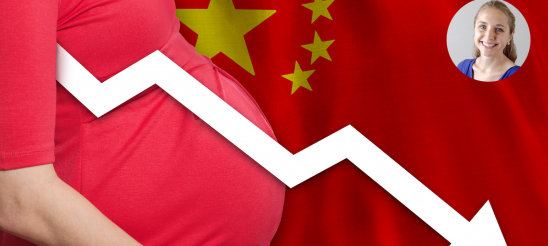
La contraction de la population chinoise pose des questions concrètes sur le modèle de croissance et les finances publiques du pays. Pas simple de modifier des normes culturelles imposées pendant des décennies, analyse Pauline Rossi dans la chronique de « Polytechnique Insights ».
Anna Korba reçoit la médaille de bronze du CNRS pour ses travaux à l’interface entre mathématiques, statistiques et intelligence artificielle

Spécialiste en apprentissage automatique au Centre de recherche en économie et statistique (CREST)1 , Anna Korba est lauréate 2026 de la médaille de bronze du CNRS pour ses travaux novateurs dans le domaine. Ses recherches portent notamment sur l’optimisation dans l’espace des mesures de probabilité et ont conduit à des avancées théoriques importantes, avec des applications en échantillonnage et en modèles génératifs.
L’assurance paramétrique : un outil au service de l’assurabilité

Une indemnisation rapide et transparente, une volatilité maîtrisée : l’assurance paramétrique est une solution prometteuse pour assurer certains risques émergents comme les catastrophes naturelles. Sous réserve de contrôler le risque de base.
Avec Olivier Lopez, pour la Caisse des Dépôts, le 03/04/2026
Risque cyber : un défi pour l’assurabilité et la stabilité financière

Le risque cyber a changé d’échelle. Il ne relève plus d’une succession d’incidents techniques isolés, mais d’une transformation profonde de l’architecture de nos économies numérisées. A l’aire des bouleversements de l’Intelligence Artificielle et des tensions géopolitiques accrues, le risque cyber constitue une menace de plus en plus importante pour le tissu économique et la stabilité financière.
Caroline Hillairet pour la Caisse des Dépôts, le 24/03/2026
CREST Column: More resilient but still exposed: European electricity markets in the shadow of the Iran War by Ruben Haalebos and Peter Tankov

Ruben Haalebos | CREST, ENSAE Paris, IP Paris and EDF R&D
Peter Tankov | CREST, ENSAE Paris, IP Paris
OPeration “Epic Fury”, launched by the United States (US) and Israel against the Iranian regime, is reshaping energy markets. Although the European Union is not directly involved, it remains exposed because of its dependence on imported fossil fuels. Following the increase of gas prices, electricity rose in Europe, as they remain relatively correlated. This increase nevertheless remained limited compared with the surge triggered by Russia’s invasion of Ukraine in February 2022. While the two shocks differ significantly in scale, both highlight Europe’s structural dependence on imported energy. This dependence leaves the continent vulnerable to external political decisions and supply-chain disruptions, underscoring the need for greater control over domestic energy production. Electrifying end uses with decarbonized electricity is one way to strengthen that control. Beyond its climate benefits, this strategy would also make the European economy more resilient. In this context, carbon markets such as the EU ETS can play a central role, provided that the revenues are directed toward energy efficiency and decarbonization investments.
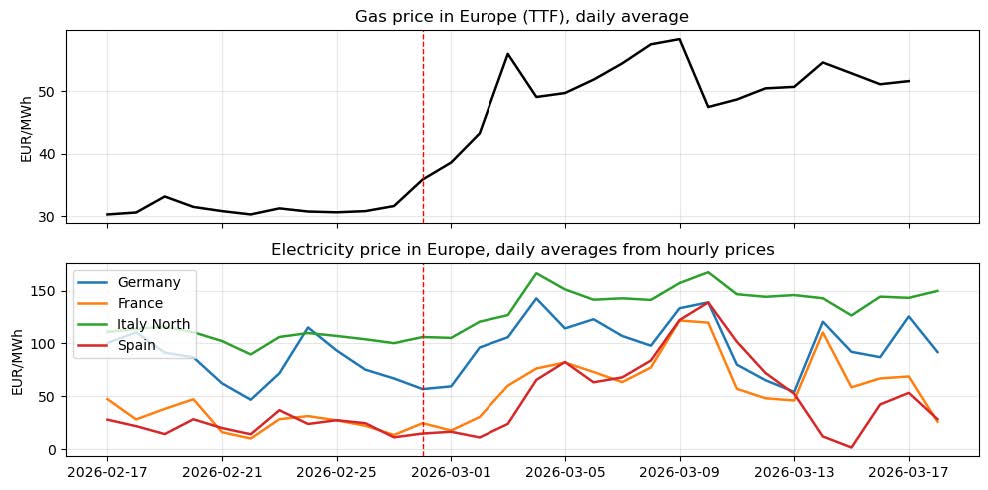
The US-Israeli military campaign against Iran is adding upward pressure to global fossil-fuel prices. The main channel is the disruption of shipping through the Strait of Hormuz, one of the world’s most important energy chokepoint. About 20% of global oil and liquefied natural gas (LNG) consumption moves through the strait [1], with limited scope for re-routing. Unsurprisingly, energy markets have responded immediately (Figure 1). European benchmark gas prices have jumped by more than 50% since the conflict began, and oil prices have also risen sharply. This has fed into European wholesale electricity prices, raising concern about renewed energy-market stress.
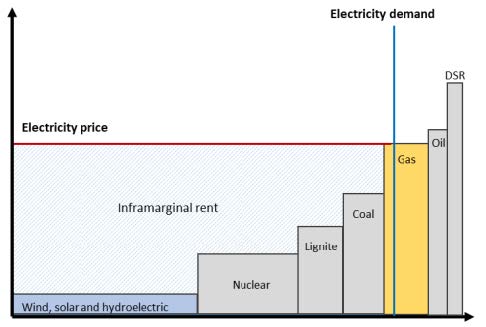
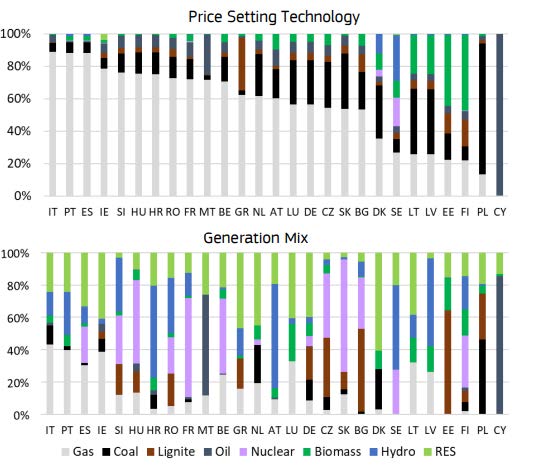
Even though the current electricity price shock is still far less severe than the one Europe experienced in 2022, the mechanisms that led to this increase are similar. As explained in [2], natural gas can have a strong influence on power prices in Europe, even though it does not dominate electricity generation. The reason lies in the marginal-pricing structure of wholesale electricity markets: prices are set by the last unit required to meet demand, as depicted in Figure 2. Gas-fired power plants frequently occupy this position, which means that gas prices can shape wholesale electricity prices far beyond gas’ direct share in the generation mix. Figure 3 illustrates this effect, for the year 2022. Because fuel costs make up a large share of the operating cost of gas-fired plants, increases in gas prices quickly feed through into electricity prices. This helps explain why the European power system remains highly exposed to volatility in gas markets and to external supply shocks [2, 3].
The present situation differs materially from that of 2022 [4]. At the time, the European energy system was already operating under unusual strain: drought depressed hydropower output in several countries, while nuclear maintenance in France further tightened electricity supply. In addition, the absence of an effective coordination mechanism meant that European gas buyers were often competing against one another in global markets. Europe is better positioned today. Installed wind and solar capacity has increased by 57% since 2021, joint gas purchasing has improved coordination, and gas demand from energy-intensive industries remains structurally below pre-crisis levels.
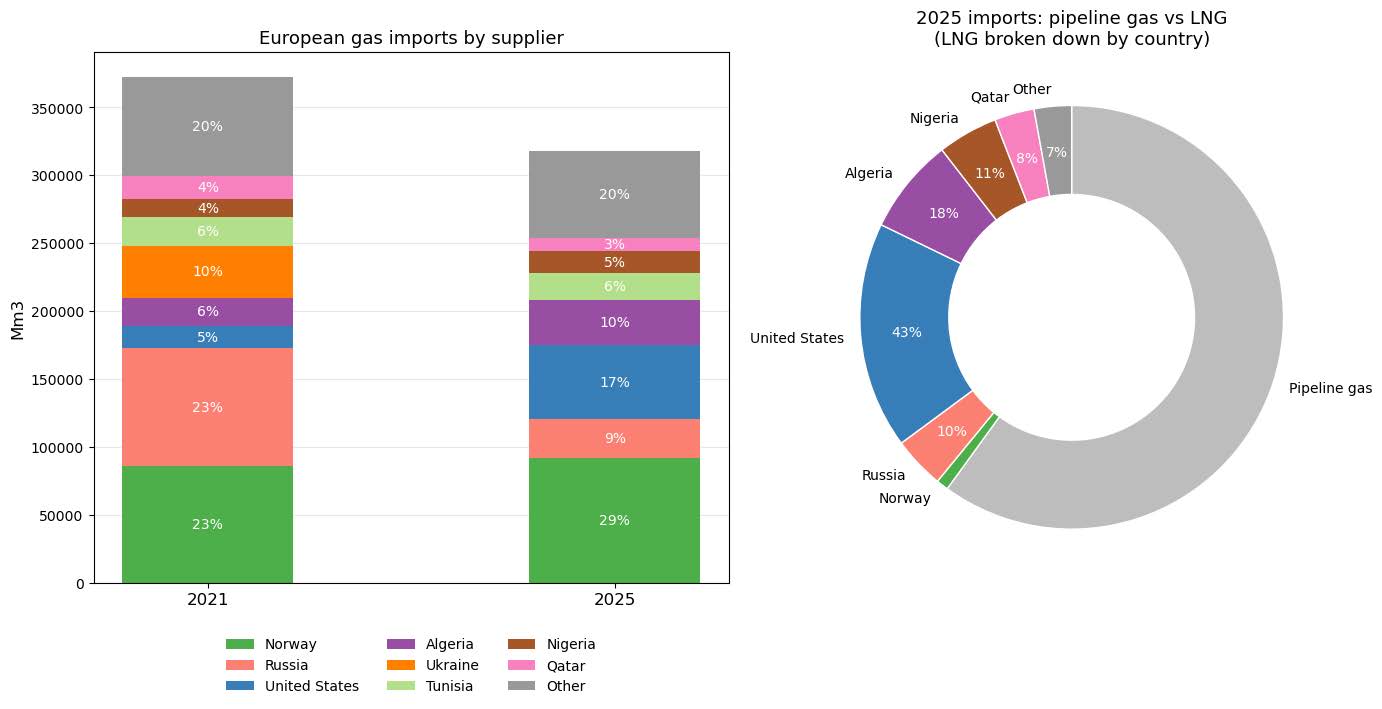
Furthermore, the nature of the shock is different. In 2022, Europe was facing a structural break in its energy supply, as replacing Russian gas required a profound reorganization of import routes and procurement strategies. Today’s shock is more narrowly geopolitical in nature. In 2021, Russian gas accounted for a little than 40% of total import¹, so reducing that dependence demanded a substantial adjustment. Since then, Europe has expanded its LNG import capacity and diversified its supply base. As Figure 4 shows, the composition of European gas imports is now very different: Russian gas no longer occupies the dominant position it once did, while imports from Norway, the US, and Algeria have become more important. LNG, especially from the United States, now plays a much larger role.
Altogether, Europe is not directly exposed to a disruption of the Strait of Hormuz in the same way it was exposed to the loss of Russian pipeline gas in 2022. Qatar accounts for only around 3,5% of the EU’s overall gas supply, so a blockade would not generate an immediate physical shortfall. The larger risk is indirect and operates through the global LNG market. Because more than 80% of Qatari LNG exports are normally shipped to Asia, any prolonged disruption would force Asian buyers to compete for alternative cargoes, tightening global LNG balances and pushing prices higher. Europe is therefore more diversified than it was in 2022, but it remains exposed to global gas-market tensions an to price shocks transmitted through LNG trade.
This exposure can be seen, in part, as a temporary consequence of its transition strategy in the power sector. Coal plants have progressively been retired and replaced by renewables and natural gas. While this has supported decarbonization, it has also left gas-fired plants in a central role in price formation, bu the mechanisms described above. This haas in turn fueled a broader political debate about the costs and design of the decarbonization agenda. The recent debate over the EU ETS reflects this tension. For example, Italian Prime Minister Giorgia Meloni called for its suspension: “With the outbreak of the crisis in the Middle East, the issue of energy prices has clearly become even more important, which is why, at European level, we are also calling for the urgent suspension of the application of the ETS to electricity production” [5].
On the contrary, we view the EU ETS as en essential tool of the European Union climate policy. As the EU’s central policy instrument for advancing decarbonization, it contributes to reducing reliance on imported fossil fuels and thereby reinforces strategic autonomy. The case for reducing Europe’s dependence on fossil fuels is not limited to long-term climate benefits and lower greenhouse-gas emissions(GIIG) emissions. It also has important short-term advantages. In a context in which multilateralism is increasingly perceived to be in retreat [6], and where geoeconomics confrontation or regional conflicts may become more frequent, energy supply chains are likely to face renewed disruption. From that perspective, the development of renewable energy is not only a decarbonization strategy, but also a resilience strategy. Although renewable technologies are not entirely detached from global supply chains-given Europe’s continued reliance on imported equipment, particularly from China-they are far less vulnerable to abrupt fuel-price spikes and external supply interruptions tan fossil-fuel-based energy systems. Decarbonizing Europe’s power system is therefore not only about climate policy; it is also about strengthening economic resilience, energy security, and strategic autonomy.
¹ This number accounts for direct supply as well as gas transiting through Belarus and Ukraine.
References
[1] Reuters. Gulf oil producers scramble to bypass Hormuz as Iran locks down the Strait, 2026.
Graphics page: Maps and charts of the Iran War. Accessed March 18, 2026.
[2] Behman Zakkers, Iain Staffell, Paul E. Dodds, Michael Grubb, Paul Ekins, Paulina Jaramillo, and Giorgio Castagneto Gissey. The Role of natural gas in setting electricity prices in europe. Energy Reports, 9: 16808*16822, 2023. ISSN 2352-4847. doi: 10.1016/j.egyr.2023.09.069.
[3] Jorge M. Uribe, Stephania Mosquera-López, and Oscar J. Arenas. Assessing the relationship between electricity and natural gas prices in european markets in times of distress. Energy Policy, 166:113018, July 2022. ISSN 0301-4215. doi: 10.1016/j.enpol.2022.113018.
[4] Warren Patterson. 7 reasons why Europe can deal with a gas shock better than in 2022, March 2026. ING THINK article, accessed March 18, 2026.
[5] Federica Di Sario. War-driven energy prices put EU carbon market under fire, March 2026. The Parliament Magazine, accessed March 18, 2026.
[6] World Economic Forum. The global risks report 2026. Global risks report, World Economic Forum, January 2026, 21st edition, published January 14, 2026.
Déserts médicaux : « On pourrait permettre à deux internes mariés ou en couple de joindre leurs choix d’affectation : d’autres pays le font »

Les couples de médecins rappellent régulièrement leur désarroi face à l’algorithme affectant les internes de médecine en France. La procédure actuelle ne leur permet pas d’obtenir des postes proches géographiquement. Pourtant, d’autres pays ont trouvé des solutions, rappelle Julien Combe, professeur à l’Ecole polytechnique.
March 8: Celebrating the Work of Women Researchers an PhD students at CREST

From climate economics to machine learning and public policy, women researchers and PhD students at CREST contribute every day to advancing knowledge and addressing major societal challenges.
Every year on March 8, International Women’s Rights Day highlights the achievements of women across society and offers an opportunity to reflect on progress toward gender equality. In academia, women researchers play a crucial role in advancing knowledge, even though they remain underrepresented in several disciplines and at senior levels.
At CREST, women researchers and PhD students contribute actively to research in economics, sociology, finance and statistics. Through their work, they help strengthen the laboratory’s international visibility while addressing some of the major economic and social challenges of our time.
Research shedding light on societal transformations
Many women researchers at CREST conduct research that directly informs debates on public policy and social change.
For example, Marion Leroutier has studied differences in carbon footprints between men and women. Her research shows that women emit on average around 26% less CO₂ than men, a gap largely explained by differences in consumption patterns, particularly in transportation and food. This work contributes to discussions on environmental policy and highlights how gendered behaviors can influence the distributional effects of climate policies.
Research conducted at CREST also addresses broader demographic and economic transformations. Studies on the decline in fertility in France and other developed countries, by Pauline Rossi in her recent book, examine the economic and social implications of demographic change, a topic that has become increasingly central to public debate.
Recognition of women researchers at CREST
The work of women researchers at CREST is regularly recognized by the international academic community.
In 2026, Yuki Tamura received the Young Female Researchers Award from the Japanese Economic Association, highlighting the growing international visibility of her research.
In statistics and machine learning, Anna Korba was awarded a prestigious ERC Starting Grant for her project OptInfinite, which aims to develop new optimization and machine learning methods in infinite-dimensional settings.
These distinctions illustrate the diversity and excellence of research conducted by women scientists at CREST across multiple disciplines.
Women contributing to economic policy and public debate
Women researchers at CREST are also actively involved in shaping economic debate and public policy.
For instance, Emmanuelle Taugourdeau and Pauline Rossi were recently appointed members of the Conseil d’analyse économique, an advisory body that provides economic expertise to the French government. Their work contributes to bringing rigorous economic analysis into policy discussions.
CREST researchers also regularly participate in public debates through media appearances and collaborations with institutions, helping to disseminate research findings beyond academia.
The role of doctoral researchers
Doctoral students are another essential component of the laboratory’s research ecosystem. Many PhD students at CREST contribute to innovative research projects in areas such as labor markets, inequality, discrimination, data science and financial economics.
In the 2025-2026 cohort, nearly half of the newly recruited PhD students are women (12 women and 15 men), reflecting CREST’s ability to attract talented young female researchers. This dynamic is an important aspect of the laboratory’s commitment to promoting diversity in academic careers, not only at the doctoral level but throughout all stages of recruitment.
Looking ahead
International Women’s Rights Day is both a moment to celebrate achievements and a reminder of the importance of continuing to promote diversity in research.
At CREST, the work of women researchers and doctoral students contributes every day to advancing knowledge and to improving our understanding of economic and social transformations.
On this March 8, we celebrate their contributions to the laboratory’s scientific life and to the broader academic community.
—
Scientific excellence depends on the diversity of perspectives within the research community. Supporting the careers of women researchers and doctoral students is therefore not only a matter of equality, but also a key condition for the vitality and impact of research. At CREST, we are committed to fostering an academic environment where talent can thrive at every stage of the scientific career.
Find more highlights by women at CREST:
Entretien avec Annina Claesson : la place des réseaux sociaux dans le quotidien parlementaire

Ce mois-ci a paru l’article d’Annina Claesson:“Le prix de la visibilité”, dans la Revue Française de Sciences Politique. Cet article s’inscrit dans son travail de thèse Se rendre visible : la place des réseaux sociaux dans le quotidien parlementaire. Son article est disponible sur site de la plateforme CAIRN.