

New offices to find, new colleagues to meet, new projects to launch this is what the start of the academic year looks like for the researchers, postdocs, PhD students, and visiting scholars joining CREST this fall.
Coming from different countries and academic traditions, they will spend the coming months – or years – contributing to our four research areas: economics, sociology, statistics, and finance-insurance, while bringing their own scientific culture to the lab.
Here is an introduction to this year’s newcomers.
Researchers
This year, several new researchers are joining CREST, strengthening our core faculty and bringing new perspectives across our disciplines.
Marshall Taylor – Computational Sociology (Groupe ENSAE-ENSAI)
Marshall Taylor joins CREST from New Mexico State University, where he was an Associate Professor of Sociology and led the C3 Lab. His research explores questions of cognition and measurement in the sociology of culture, with a particular focus on how cultural knowledge is structured and studied.
Juliette Saetre – Sociology (Groupe ENSAE-ENSAI)
Juliette Saetre arrives from Toulouse School of Economics, where she was an IAST Postdoctoral Research Fellow; she received her PhD from the European University Institute. Her research examines how political attitudes and behaviors diffuse through migrant populations, reshaping political dynamics in receiving communities, with a broader interest in protest and collective action, migration, social networks, and diffusion.
Camille Urvoy – Economics (École polytechnique)
Camille Urvoy is currently an Assistant Professor of Economics at the University of Mannheim; she received her PhD from Sciences Po in 2021. Her work sits at the intersection of media economics and political economy. Camille Urvoy will join CREST in January 2027.
Maxim Sandiumenge-i-Boy – Economics (Télécom Paris)
Maxim Sandiumenge-i-Boy joins CREST as Assistant Professor of Economics in Fall 2026, following his PhD in Economics at Toulouse School of Economics. His research spans industrial organization, competition policy, computational methods, and machine learning.
Elliot Motte – Economics (Groupe ENSAE-ENSAI)
Elliot Motte received his PhD from Universitat Pompeu Fabra in June 2026. He will first take up a postdoctoral fellowship at the University of New South Wales in Fall 2026, before joining CREST-ENSAI as Assistant Professor of Economics in Fall 2027. A political economist, he is particularly interested in how media shapes public beliefs and behaviors.
Guillermo Alonso Alvarez – Finance-Insurance (Groupe ENSAE-ENSAI)
Guillermo Alonso Alvarez joins the Finance-Insurance team as Assistant Professor in Fall 2026. He was previously a Postdoctoral Fellow at the University of Michigan and received his PhD from Illinois Institute of Technology. His research interests include stochastic control, contract theory, mean-field games, machine learning, and financial and actuarial mathematics.
Postdoctoral Fellows
Our new postdoctoral researchers are contributing to ongoing projects and launching their own work in close collaboration with CREST teams.
- Davide Bordoli, Economics, with Olivier Gossner.
- Nassim Bourarach, Statistics
- Julia Francesca Engel, Economics, with Yves Le Yaouanq.
- David Heredia, Statistics, with Sébastien Da Veiga
- Arouna Kouandou, Statistics-Computer Science, ATER position
- Luisa Lore, Economics, with Matias Nunez.
- Grégoire Jacquemin, Finance-Insurance, with Olivier Lopez.
- Joao Miguel Machado, Statistics, with Anna Korba.
- Hugo Martin, Statistics-Computer Science, ATER position
- Siwan Boufadène, Statistics, with Anna Korba.
- Martin Rouault, Statistics, with Anna Korba.
- Remi Castera, Statistics, with Vianney Perchet.
- Emmanuel Esposito, Statistics, with Vianney Perchet.
PhD Students
This year, we welcome a new cohort of PhD students who are beginning their research journeys within our vibrant academic community.
23 new PhD students are joining CREST across our research clusters: 6 in the Economics team, 3 in Finance-Insurance, 10 in Statistics, and 4 in Sociology. 2 of them will join us on the CREST-ENSAI campus in Bruz, while the rest will be based at the CREST-ENSAE Paris or Télécom Paris campuses in Palaiseau.
Visiting Researchers and PhD Students
CREST is also hosting 13 visiting researchers and PhD students this year, joining us for research stays that foster international collaboration.
- Gerard Camats Penella, PhD student at Universitat Autònoma de Barcelona, Spain, joins the Economics team to work with Giovanni Ricco on monetary policy and financial markets.
- Clara-Marie Pache, PhD student at Leipzig University, Germany, joins the Economics team to work with Pierre Boyer on the relationship between scientific evidence and public policymaking.
- Mahmut Sefa Ipek, PhD student at Bilkent University, Turkey, joins the Economics team to work with Giovanni Ricco on monetary policy transmission and macroeconomic dynamics.
- Léopold Dubreuil, Public Administrator, France, joins the Economics team to work with Pierre Boyer on corporate taxation and fiscal integration in the European Union.
- Bertille Antoine, researcher at Simon Fraser University, Canada, joins the Economics team to work with Xavier d’Haultfœuille on econometrics and financial econometrics.
- András Fülöp, researcher at ESSEC Business School, France, joins the Statistics team to work with Nicolas Chopin on Bayesian inference methods for econometrics and finance.
- Anna Rae George, PhD student at the University of Oxford, UK, joins the Sociology team to work with Etienne Ollion on computational approaches to online communication.
- Julia Pickersgill, PhD student at the École des Hautes Études en Sciences Sociales, Switzerland, joins the Economics team to work with Enrico Rubolino on gender inequality and public policy.
- Anna Pajola, PhD student at Bielefeld University, Germany, joins the Finance-Insurance team to work with Roxana Dumitrescu on mean-field games and stochastic control.
- Jiayu Liu, PhD student at the TUM School of Computation, Information and Technology, Germany, joins the Statistics team to work with Vianney Perchet on learning-augmented online algorithms.
- Taylor Brenden Alarcon, PhD student at Columbia University, USA, joins the Sociology team to work with Hesu Yoon on gentrification and the use of urban public space.
- Carla Ruggiu, PhD student at Panthéon-Sorbonne, France, joins the Economics team to work with Enrico Rubolino on work-family trade-offs and fertility.
- Louise Brandily, PhD student at Panthéon-Sorbonne, France, joins the Economics team to work with Pierre Boyer on public budgetary frameworks.
A Thriving PhD Community: Two Doctoral-Led Research Events at CREST This June

June was a busy and rewarding month for CREST’s doctoral community. Within the space of two weeks, PhD students took the lead in organizing two research events: the annual PhD Workshop for first-year economics students, and the very first edition of the Junior Finance Research Day. Together, they offer a good snapshot of a doctoral community that is active, well organized, and genuinely invested in its own scientific life.
PhD Workshop: a yearly tradition for first-year economists
On June 22 and 23, CREST hosted its annual PhD Workshop for first-year economics PhD students. This yearly event gives every first-year student the chance to present their ongoing research to the entire lab, faculty and fellow PhD students alike. It is also one of the last convivial moments of the academic year, with an afterwork and a shared meal bringing the group together outside the seminar room.
For first-year students, the workshop is a real opportunity: presenting their work in front of an audience, gathering valuable feedback from both senior researchers and peers, and discovering the research topics and methods of their colleagues. These exchanges, spanning different fields of economics, often spark ideas for future collaborations and give students their first experience presenting in a formal workshop setting.
Over the two days, the programme covered an impressive range of topics — from monetary policy and the green transition to firm-level innovation, matching theory, demography and the family, labor economics, and environmental economics — a good illustration of just how broad the research interests of CREST’s younger generation already are.
Between sessions, the coffee breaks played their usual essential role: moments of connection between PhD students and faculty, fostering informal discussions about the presentations and sparking new scientific conversations.
Junior Finance Research Day: a new tradition takes shape
New this year: the first Junior Finance Research Day brought together PhD students, postdoctoral researchers and faculty members from the Finance group at CREST for a full day of presentations and scientific exchange. Organized jointly with the Financial Mathematics Seminar — itself a sign of the collaborative spirit driving the initiative — the event gave junior researchers the opportunity to present their ongoing work, receive feedback from peers and faculty, and engage in discussion across a broad spectrum of finance research.
Unlike workshops devoted exclusively to first-year PhD students, this event deliberately brought together researchers at different stages of their academic careers, widening the conversation and the range of perspectives in the room.
One of the defining features of the day was the sheer variety of research topics on display, from sustainable finance and climate risk to financial mathematics and econometrics, combining theoretical modelling, quantitative analysis and advanced statistical techniques. Presentations included Ruben Haalebos on carbon-intensity factor models for portfolio choice, Reda Alami Chentoufi on Graphical LASSO for MGARCH models, Thomas Peyrat on Malliavin calculus applied to cyber risk, Davide Stocco on blended finance for biodiversity conservation, Grégoire Jacquemin on the statistical modelling of compound climate events, Lishu Zhang on critical raw material dependency risk, Carolina Moura on how financial markets react to climate compound events, Laura D’Andolfi on a new probabilistic approach to mean field games of optimal stopping, and Richard Ahouansou on neural network estimation of extreme value copulas.
Beyond the presentations themselves, a second, equally important goal of the day was to strengthen the sense of community within the Finance group — encouraging collaboration, facilitating the exchange of ideas, and laying the groundwork for future research interactions.
A community that organizes itself
What stands out across both events is that they were designed, driven and run by the doctoral students themselves. From building the programme to coordinating logistics and bringing colleagues from different cohorts and specialties together, this June’s events reflect a PhD community at CREST that is not only large and diverse, but proactive in creating its own spaces for exchange, feedback and collaboration — a strong sign of the collective dynamism running through the lab’s next generation of researchers.
Thank you to the PhD organizers for these two events, Laurine Meier, Hervé Darricau, Laura D’Andolfi, and Eugenio Parigi!
Roxana Dumitrescu wins the 2026 EIF–SCOR Foundation Prize

We are delighted to share that Roxana Dumitrescu (CREST – Groupe ENSAE-ENSAI) has been awarded the 2026 EIF–SCOR Foundation Prize of the Institut Louis Bachelier in the category of Best Young Researcher in Finance and Insurance.
Roxana is an expert in stochastic control and financial mathematics, with a broad research scope. Her recent work significantly advances mean field game theory and its applications, particularly in the context of the energy transition.
Established in 2005, the prize is awarded annually to researchers under 40 who have made a significant contribution to finance, insurance, or risk analysis.
This year, the prize is jointly awarded to Roxana Dumitrescu and Sylvain Carré (Université Paris 1 Panthéon-Sorbonne). The award was presented by Elyès Jouini, Academic Vice-President of the Institut Louis Bachelier, alongside a representative of the SCOR Foundation.
This recognition speaks to the exceptional quality of her research and the growing attention it is attracting across the academic community.
Everyone at CREST extends their warmest congratulations to Roxana on this well-deserved achievement.
L’assurance paramétrique : un outil au service de l’assurabilité

Une indemnisation rapide et transparente, une volatilité maîtrisée : l’assurance paramétrique est une solution prometteuse pour assurer certains risques émergents comme les catastrophes naturelles. Sous réserve de contrôler le risque de base.
Avec Olivier Lopez, pour la Caisse des Dépôts, le 03/04/2026
Risque cyber : un défi pour l’assurabilité et la stabilité financière

Le risque cyber a changé d’échelle. Il ne relève plus d’une succession d’incidents techniques isolés, mais d’une transformation profonde de l’architecture de nos économies numérisées. A l’aire des bouleversements de l’Intelligence Artificielle et des tensions géopolitiques accrues, le risque cyber constitue une menace de plus en plus importante pour le tissu économique et la stabilité financière.
Caroline Hillairet pour la Caisse des Dépôts, le 24/03/2026
CREST Column: More resilient but still exposed: European electricity markets in the shadow of the Iran War by Ruben Haalebos and Peter Tankov

Ruben Haalebos | CREST, ENSAE Paris, IP Paris and EDF R&D
Peter Tankov | CREST, ENSAE Paris, IP Paris
OPeration “Epic Fury”, launched by the United States (US) and Israel against the Iranian regime, is reshaping energy markets. Although the European Union is not directly involved, it remains exposed because of its dependence on imported fossil fuels. Following the increase of gas prices, electricity rose in Europe, as they remain relatively correlated. This increase nevertheless remained limited compared with the surge triggered by Russia’s invasion of Ukraine in February 2022. While the two shocks differ significantly in scale, both highlight Europe’s structural dependence on imported energy. This dependence leaves the continent vulnerable to external political decisions and supply-chain disruptions, underscoring the need for greater control over domestic energy production. Electrifying end uses with decarbonized electricity is one way to strengthen that control. Beyond its climate benefits, this strategy would also make the European economy more resilient. In this context, carbon markets such as the EU ETS can play a central role, provided that the revenues are directed toward energy efficiency and decarbonization investments.
The US-Israeli military campaign against Iran is adding upward pressure to global fossil-fuel prices. The main channel is the disruption of shipping through the Strait of Hormuz, one of the world’s most important energy chokepoint. About 20% of global oil and liquefied natural gas (LNG) consumption moves through the strait [1], with limited scope for re-routing. Unsurprisingly, energy markets have responded immediately (Figure 1). European benchmark gas prices have jumped by more than 50% since the conflict began, and oil prices have also risen sharply. This has fed into European wholesale electricity prices, raising concern about renewed energy-market stress.
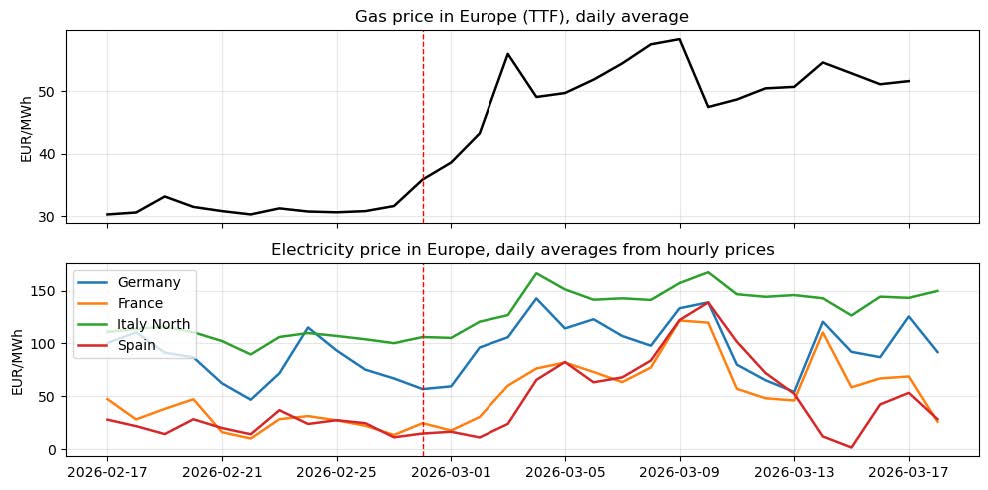
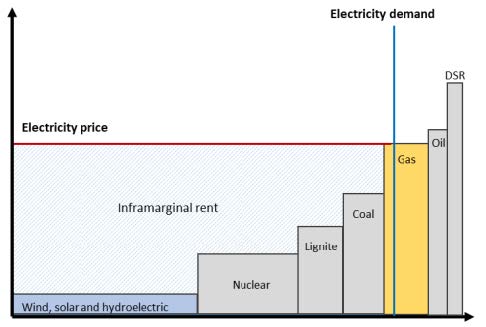
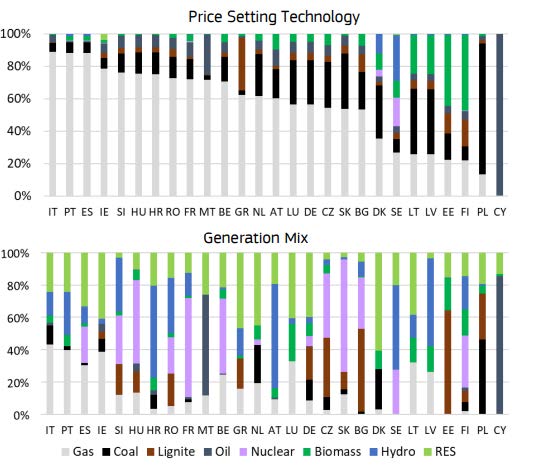
Even though the current electricity price shock is still far less severe than the one Europe experienced in 2022, the mechanisms that led to this increase are similar. As explained in [2], natural gas can have a strong influence on power prices in Europe, even though it does not dominate electricity generation. The reason lies in the marginal-pricing structure of wholesale electricity markets: prices are set by the last unit required to meet demand, as depicted in Figure 2. Gas-fired power plants frequently occupy this position, which means that gas prices can shape wholesale electricity prices far beyond gas’ direct share in the generation mix. Figure 3 illustrates this effect, for the year 2022. Because fuel costs make up a large share of the operating cost of gas-fired plants, increases in gas prices quickly feed through into electricity prices. This helps explain why the European power system remains highly exposed to volatility in gas markets and to external supply shocks [2, 3].
The present situation differs materially from that of 2022 [4]. At the time, the European energy system was already operating under unusual strain: drought depressed hydropower output in several countries, while nuclear maintenance in France further tightened electricity supply. In addition, the absence of an effective coordination mechanism meant that European gas buyers were often competing against one another in global markets. Europe is better positioned today. Installed wind and solar capacity has increased by 57% since 2021, joint gas purchasing has improved coordination, and gas demand from energy-intensive industries remains structurally below pre-crisis levels.
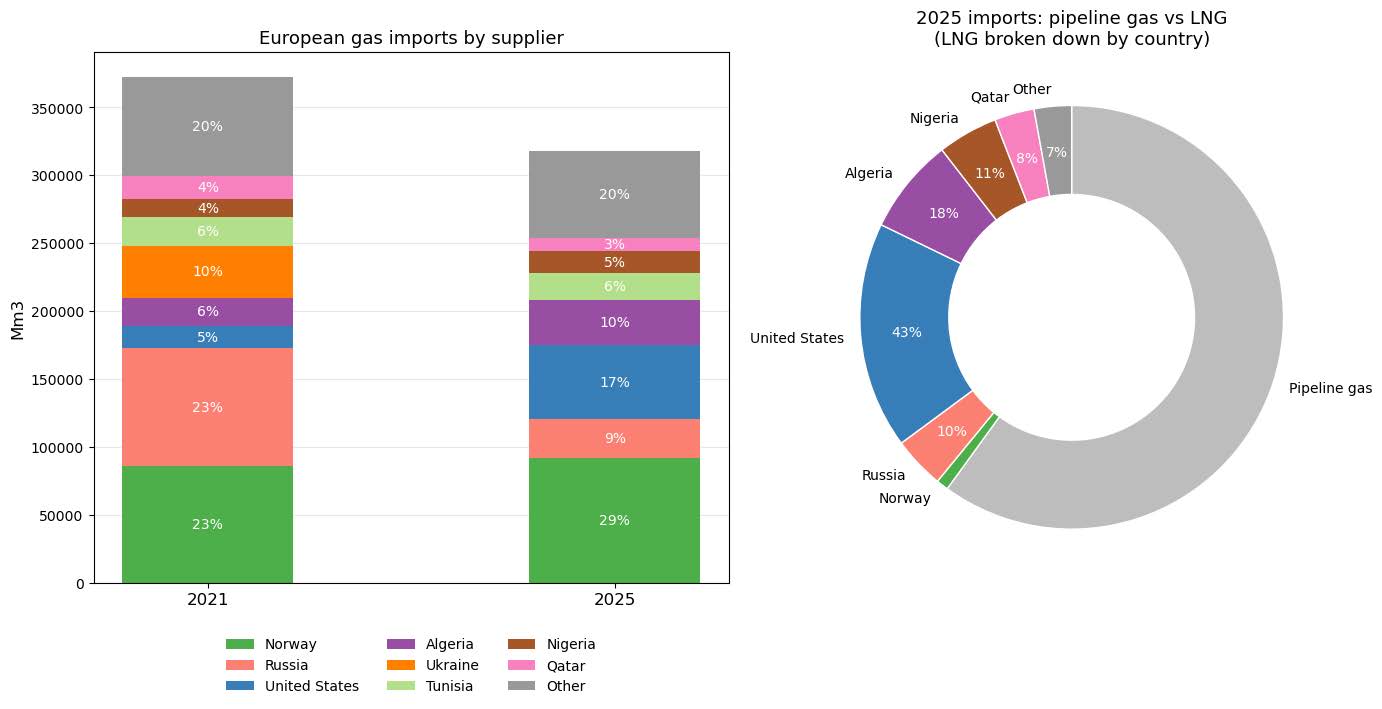
Furthermore, the nature of the shock is different. In 2022, Europe was facing a structural break in its energy supply, as replacing Russian gas required a profound reorganization of import routes and procurement strategies. Today’s shock is more narrowly geopolitical in nature. In 2021, Russian gas accounted for a little than 40% of total import¹, so reducing that dependence demanded a substantial adjustment. Since then, Europe has expanded its LNG import capacity and diversified its supply base. As Figure 4 shows, the composition of European gas imports is now very different: Russian gas no longer occupies the dominant position it once did, while imports from Norway, the US, and Algeria have become more important. LNG, especially from the United States, now plays a much larger role.
Altogether, Europe is not directly exposed to a disruption of the Strait of Hormuz in the same way it was exposed to the loss of Russian pipeline gas in 2022. Qatar accounts for only around 3,5% of the EU’s overall gas supply, so a blockade would not generate an immediate physical shortfall. The larger risk is indirect and operates through the global LNG market. Because more than 80% of Qatari LNG exports are normally shipped to Asia, any prolonged disruption would force Asian buyers to compete for alternative cargoes, tightening global LNG balances and pushing prices higher. Europe is therefore more diversified than it was in 2022, but it remains exposed to global gas-market tensions an to price shocks transmitted through LNG trade.
This exposure can be seen, in part, as a temporary consequence of its transition strategy in the power sector. Coal plants have progressively been retired and replaced by renewables and natural gas. While this has supported decarbonization, it has also left gas-fired plants in a central role in price formation, bu the mechanisms described above. This haas in turn fueled a broader political debate about the costs and design of the decarbonization agenda. The recent debate over the EU ETS reflects this tension. For example, Italian Prime Minister Giorgia Meloni called for its suspension: “With the outbreak of the crisis in the Middle East, the issue of energy prices has clearly become even more important, which is why, at European level, we are also calling for the urgent suspension of the application of the ETS to electricity production” [5].
On the contrary, we view the EU ETS as en essential tool of the European Union climate policy. As the EU’s central policy instrument for advancing decarbonization, it contributes to reducing reliance on imported fossil fuels and thereby reinforces strategic autonomy. The case for reducing Europe’s dependence on fossil fuels is not limited to long-term climate benefits and lower greenhouse-gas emissions(GIIG) emissions. It also has important short-term advantages. In a context in which multilateralism is increasingly perceived to be in retreat [6], and where geoeconomics confrontation or regional conflicts may become more frequent, energy supply chains are likely to face renewed disruption. From that perspective, the development of renewable energy is not only a decarbonization strategy, but also a resilience strategy. Although renewable technologies are not entirely detached from global supply chains-given Europe’s continued reliance on imported equipment, particularly from China-they are far less vulnerable to abrupt fuel-price spikes and external supply interruptions tan fossil-fuel-based energy systems. Decarbonizing Europe’s power system is therefore not only about climate policy; it is also about strengthening economic resilience, energy security, and strategic autonomy.
¹ This number accounts for direct supply as well as gas transiting through Belarus and Ukraine.
References
[1] Reuters. Gulf oil producers scramble to bypass Hormuz as Iran locks down the Strait, 2026.
Graphics page: Maps and charts of the Iran War. Accessed March 18, 2026.
[2] Behman Zakkers, Iain Staffell, Paul E. Dodds, Michael Grubb, Paul Ekins, Paulina Jaramillo, and Giorgio Castagneto Gissey. The Role of natural gas in setting electricity prices in europe. Energy Reports, 9: 16808*16822, 2023. ISSN 2352-4847. doi: 10.1016/j.egyr.2023.09.069.
[3] Jorge M. Uribe, Stephania Mosquera-López, and Oscar J. Arenas. Assessing the relationship between electricity and natural gas prices in european markets in times of distress. Energy Policy, 166:113018, July 2022. ISSN 0301-4215. doi: 10.1016/j.enpol.2022.113018.
[4] Warren Patterson. 7 reasons why Europe can deal with a gas shock better than in 2022, March 2026. ING THINK article, accessed March 18, 2026.
[5] Federica Di Sario. War-driven energy prices put EU carbon market under fire, March 2026. The Parliament Magazine, accessed March 18, 2026.
[6] World Economic Forum. The global risks report 2026. Global risks report, World Economic Forum, January 2026, 21st edition, published January 14, 2026.
March 8: Celebrating the Work of Women Researchers an PhD students at CREST


From climate economics to machine learning and public policy, women researchers and PhD students at CREST contribute every day to advancing knowledge and addressing major societal challenges.
Every year on March 8, International Women’s Rights Day highlights the achievements of women across society and offers an opportunity to reflect on progress toward gender equality. In academia, women researchers play a crucial role in advancing knowledge, even though they remain underrepresented in several disciplines and at senior levels.
At CREST, women researchers and PhD students contribute actively to research in economics, sociology, finance and statistics. Through their work, they help strengthen the laboratory’s international visibility while addressing some of the major economic and social challenges of our time.
Research shedding light on societal transformations
Many women researchers at CREST conduct research that directly informs debates on public policy and social change.
For example, Marion Leroutier has studied differences in carbon footprints between men and women. Her research shows that women emit on average around 26% less CO₂ than men, a gap largely explained by differences in consumption patterns, particularly in transportation and food. This work contributes to discussions on environmental policy and highlights how gendered behaviors can influence the distributional effects of climate policies.
Research conducted at CREST also addresses broader demographic and economic transformations. Studies on the decline in fertility in France and other developed countries, by Pauline Rossi in her recent book, examine the economic and social implications of demographic change, a topic that has become increasingly central to public debate.
Recognition of women researchers at CREST
The work of women researchers at CREST is regularly recognized by the international academic community.
In 2026, Yuki Tamura received the Young Female Researchers Award from the Japanese Economic Association, highlighting the growing international visibility of her research.
In statistics and machine learning, Anna Korba was awarded a prestigious ERC Starting Grant for her project OptInfinite, which aims to develop new optimization and machine learning methods in infinite-dimensional settings.
These distinctions illustrate the diversity and excellence of research conducted by women scientists at CREST across multiple disciplines.
Women contributing to economic policy and public debate
Women researchers at CREST are also actively involved in shaping economic debate and public policy.
For instance, Emmanuelle Taugourdeau and Pauline Rossi were recently appointed members of the Conseil d’analyse économique, an advisory body that provides economic expertise to the French government. Their work contributes to bringing rigorous economic analysis into policy discussions.
CREST researchers also regularly participate in public debates through media appearances and collaborations with institutions, helping to disseminate research findings beyond academia.
The role of doctoral researchers
Doctoral students are another essential component of the laboratory’s research ecosystem. Many PhD students at CREST contribute to innovative research projects in areas such as labor markets, inequality, discrimination, data science and financial economics.
In the 2025-2026 cohort, nearly half of the newly recruited PhD students are women (12 women and 15 men), reflecting CREST’s ability to attract talented young female researchers. This dynamic is an important aspect of the laboratory’s commitment to promoting diversity in academic careers, not only at the doctoral level but throughout all stages of recruitment.
Looking ahead
International Women’s Rights Day is both a moment to celebrate achievements and a reminder of the importance of continuing to promote diversity in research.
At CREST, the work of women researchers and doctoral students contributes every day to advancing knowledge and to improving our understanding of economic and social transformations.
On this March 8, we celebrate their contributions to the laboratory’s scientific life and to the broader academic community.
—
Scientific excellence depends on the diversity of perspectives within the research community. Supporting the careers of women researchers and doctoral students is therefore not only a matter of equality, but also a key condition for the vitality and impact of research. At CREST, we are committed to fostering an academic environment where talent can thrive at every stage of the scientific career.
Find more highlights by women at CREST:
Noncausal AR processes driven by causal GARCH volatility
CREST Working Papers Series No. 2026-02
by Daniel Velasquez-Gaviria and Jean-Michel Zakoïan
2025 CREST Highlights

As 2025 draws to a close, CREST reflects on a year marked by outstanding research achievements, prestigious recognitions, and impactful initiatives. Below is an overview of the laboratory’s key highlights.
This year was notably marked by CREST’s evaluation by HCERES, which recognised the laboratory as an excellent multidisciplinary research centre, particularly for the quality of its publications and its strong international visibility.
In 2025, CREST also organised its first retreat, a collective event dedicated to reflecting on the future of the laboratory and initiating concrete measures to improve laboratory life, internal communication, and the consideration of key issues such as research organisation, environmental policy, and international inclusion.
Key figures
- Researchers | 112
- PhD candidates | 100 PhD currently enrolled at CREST-Institut Polytechnique de Paris
- ERC Grants | 9 ERC grants in Economics, Sociology, and Statistics
Doctoral training
In 2025, CREST organised a series of doctoral courses delivered by professors from leading universities (MIT, Oxford, University of Tokyo, among others), offering advanced training to ENSAE Paris students and, in particular, to CREST PhD candidates. These courses enabled doctoral researchers to deepen their theoretical and methodological skills while engaging with cutting-edge research developed in academic environments beyond CREST.
20 PhD candidates graduated from CREST-IP Paris in 2025, pursuing a wide range of high-level career paths across academia, the public sector, and industry. Several alumni secured academic positions as Assistant Professors at institutions such as LMU Munich, ETH Zurich, and Hitotsubashi University. Other joined key public institutions, including a position as Head of the Families Study Section at INSEE, or transitioned to the private sector as Applied Scientist at Amazon and Economist at Malt. These placements reflect CREST’s strong commitment to doctoral training and its ability to prepare PhD graduates for impactful careers across sectors.
Research Breakthroughs: 204 Publications
In 2025, CREST published 204 scientific contributions, including conference papers presented at major international venues. Nearly 80% of these publications appeared in top Q1 journals, reflecting the breadth and depth of research conducted across the laboratory’s clusters.
Selected highlights include:
The Negligible Effect of Free Contraception on Fertility: Experimental Evidence from Burkina Faso, Pascaline Dupas, Seema Jayachandran, Adriana Lleras-Muney, Pauline Rossi, American Economic Review
From Public Labs to Private Firms: Magnitude and Channels of Local R&D Spillovers, Antonin Bergeaud, Arthur Guillouzouic, Emeric Henry, Clément Malgouyres, Quarterly Journal of Economics
The Biodiversity Premium, Guillaume Coqueret, Thomas Giroux, Olivier-David Zerbib, Ecological Economics
Propagation of a Carbon Price in a Credit Portfolio through Macroeconomic Factors, Géraldine Bouveret, Jean-François Chassagneux, Smail Ibbou, Antoine J. Jacquier, Lionel Sopgoui, SIAM Journal on Financial Mathematics
Machine Bias: How Do Generative Language Models Answer Opinion Polls?, Julien Boelaert, Samuel Coavoux, Etienne Ollion, Ivaylo Petev, Patrick Präg, Sociological Methods & Research
Beyond Indices: Profiles of Social Vulnerability Gap in Disaster Risk Perception, Eric Tate, Samuel Rufat, Md Asif Rahman, Shelley Hoover, International Journal of Disaster Risk Reduction
Mapping Cells trough Time and Space with MOSCOT, Dominik Klein et al., Nature
Asymptotic Equivalence of Locally Stationary Processes and Bivariate Gaussian White Noise, Cristina Butucea, Alexander Meister, Angelika Rohde, Annals of Statistics
Discover more CREST publications on our HAL webpage.
Impactful Events and Conferences
Throughout the year, CREST actively participated in and hosted events fostering collaboration and scientific exchange, including:
- Exploring Political and Economic Dynamics: A Conference with Guido Tabellini
- Summer School on Environmental Data Collection and Analysis for the Social Sciences
- Conference on Neural Information Processing Systems (NeurIPS) and CREST’s 19 accepted papers
- Navigating the Future of Money: The Futures of Money Workshop
- Paola Tubaro at Buenos Aires’ “Nuit des Idées” on the Invisible Workforce Behind AI
- Summer Institute in Computational Social Sciences with a focus on large language models and generative AI
Join future events: visit our calendar
Chairs and Research Structures
In 2025, CREST welcomed two new chairs:
- CARE | Assurabilité des Risques Emergents, led by Olivier Lopez, focusing on climate risk modelling, risk coverage and distribution mechanisms, and prevention strategies, with Allianz IARD, Institut Louis Bachelier, Fondation du Risque. More information here.
- Hi! Paris Chair, led by Etienne Ollion, developing the Textual Politics, project on the transformation of political analysis through natural language processing. More information here.
Awards and Recognitions
CREST researchers received numerous distinctions in 2025, including:
- ERC Advanced Grant awarded to Arnak Dalalyan for Statistical Analysis of Generative Models: Sampling Guarantees and Robustness (SAGMOS)
- ERC Starting Grant awarded to Anna Korba for Efficient Infinite-Dimensional Optimization over Measures (OptInfinite)
- Etienne Ollion, honourable mention by the American Political Science Associate for his book The Candidates
- Maddalena Conte, recipient of the Philippe Martin Best Thesis Award in Economics for her work on highlighting the decisive role of professional networks, access to housing, and business location in regional inequalities.
- Thomas Giroux, recipient of the 2025 Award for Young Researchers in Green Finance from the Banque de France.
Several CREST researchers were also appointed to key institutional roles, including the Conseil d’Analyse Economique, for Emmanuelle Taugourdeau and Pauline Rossi, Patricia Crifo was named a Senior Advisor at la Cour des Comptes. Julien Prat was named Head of the Department of Economics-Sociology at Institut Polytechnique de Paris.
Books, Projects, and Initiatives
In 2025, CREST researchers authored and contributed to major collective works and projects:
- Handbook of Quantitative Finance, edited by Peter Tankov and Ruixing Zhang, addressing sustainability, climate risk, regulation, and sustainable financial instruments.
- Google has again supported CREST researchers:
- Anna Korba for her project “Optimizing Diffusion Models via Generative Bilevel Learning“
- Vianney Perchet for his project “Design, Incentivization, Optimization and (Reinforcement-)Learning of Multi-Layered Market“
- Guillaume Hollard launched OrienteExpress, a research project with Ecole polytechnique and Docaposte (Index Education) on AI for career guidance and equal opportunities.
- Observatory of Equal Opportunities, jointly launched by IP Paris, the Ecoles Normales Supérieures, and the Institut des Politiques Publiques, with CREST researchers contributing to the analysis of inequalities in access to elite higher education.
This year also marked the third season of the Beyond the PhD video series, featuring Benoît Schmutz-Bloch, Caroline Hillairet, Paola Tubaro, and Nicolas Chopin, who shared their thoughts on the PhD journey, its impact on their careers, and the broader role of research in society.
Media and Outreach
In 2025, CREST researchers were featured in:
- More than 100 media outlets, including, Le Monde, Les Echos, France Culture, Libération, and La Tribune.
- 24+ op-eds and expert articles contributing to public debate.
Featured interview: Béatrice Cherrier discusses the 2025 Nobel Prize in Economics. Listen here.
International Scientific Exchange
In 2025, CREST organised 228 research seminars across macroeconomics, applied microeconomics, sociology, finance and financial econometrics, quantitative sustainable economics and finance, statistics, actuarial science, mathematical finance, and AI for social sciences. Researchers from 20 countries were invited, representing institutions across North America, Europe, and Asia, including UCLA, MIT, Yale, Columbia, Northwestern, Oxford, LSE, ETH Zurich, Bocconi, HEC Lausanne, KU Leuven, LMU, Toronto, Waseda, and Osaka University. This extensive programme further reinforced CREST’s role as a central hub for international research dialogue.
CREST celebrated a year of remarkable achievements and meaningful contributions to research, society, and global debates. From groundbreaking publications to prestigious awards and high-level scientific exchanges, CREST community continues to push boundaries and foster innovation.
Looking ahead, CREST remains committed to advancing interdisciplinary research, addressing major societal challenges, and nurturing a collaborative and inclusive environment for researchers and students alike.
Thomas Giroux lauréat du Prix du meilleur jeune chercheur en finance verte de la Banque de France

Thomas Giroux, ancien doctorant du CREST ayant récemment soutenu sa thèse “Walking the talk of impact investing”, a reçu le Prix du meilleur jeune chercheur en finance verte 2025 décerné par la Banque de France, le 17 décembre 2025, à l’occasion de la conférence Green Finance Research Advances (GFRA).
Cette distinction prestigieuse récompense des travaux de recherche de très haut niveau contribuant à l’analyse des enjeux financiers liés à la transition environnementale. Elle vient couronner un parcours académique remarquable : Thomas Giroux a récemment été recruté en tant qu’Assistant Professor à l’ETH Zurich, l’une des institutions les plus réputées au niveau international.
Ce prix revêt également une dimension symbolique forte pour le CREST. En effet, Olivier-David Zerbib, chercheur au CREST et Professeur à l’ENSAE Paris, avait lui-même reçu ce prix en 2020. Avec cette nouvelle distinction, le CREST compte désormais deux lauréats de ce prix, confirmant son positionnement de premier plan dans le champ de la finance environnementale et de la finance verte.
Le CREST adresse ses chaleureuses félicitations à Thomas Giroux pour cette reconnaissance majeure et se réjouit de voir ses anciens doctorants contribuer activement aux avancées de la recherche internationale sur les enjeux climatiques et financiers.
👉 Plus d’informations sur le Prix Jeunes Chercheurs en finance verte de la Banque de France